

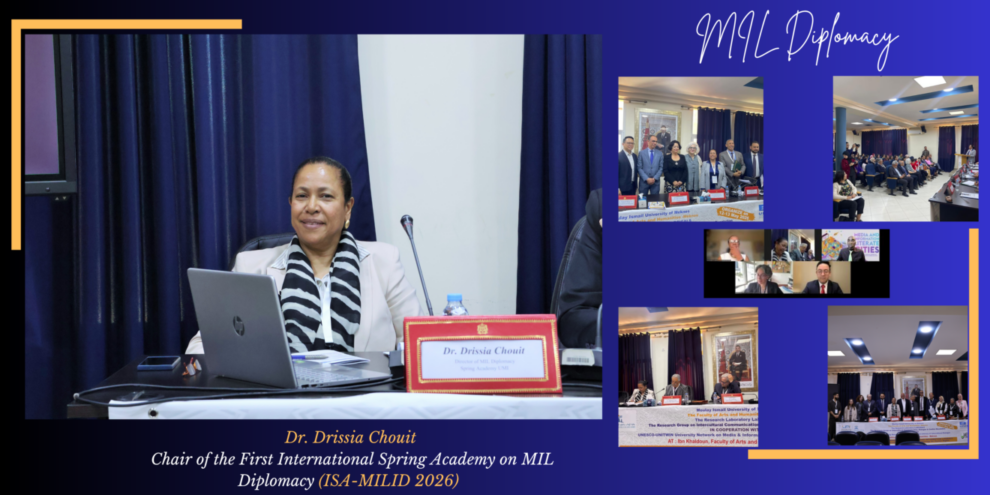

Interview with Professor Drissia Chouit
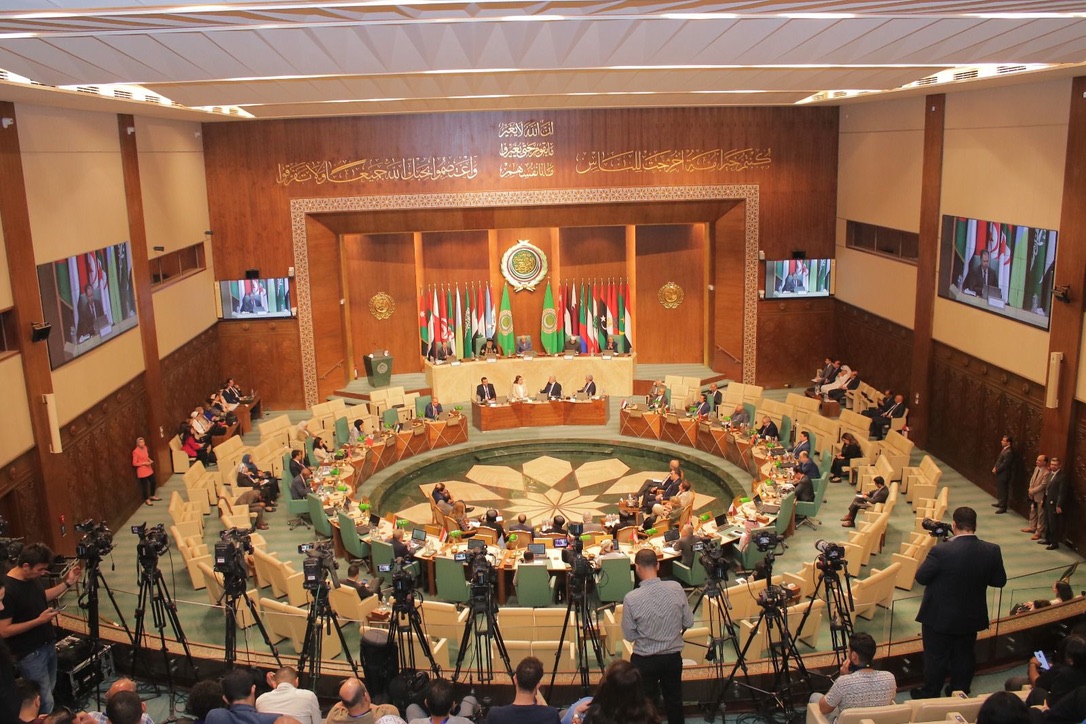
In the era of Generative Artificial Intelligence and amid the global erosion of trust and rising disinformation, safeguarding digital human rights has become an urgent necessity. It is against this rapidly evolving backdrop that the ground-breaking First International Spring Academy on Media and Information Literacy Diplomacy (ISA-MILID 2026) took place on May 12–13, 2026, at Moulay Ismail University of Meknes, Morocco. This milestone event was strategically organized to commemorate two major celebrations: the15th Anniversary of the UNESCO-UNITWIN University Network on Media and Information Literacy and Intercultural Dialogue (UNESCO-MILID), and World Press Freedom Day (WPFD 2026), which focused this year on the critical theme of Digital Human Rights. Bringing together academics, diplomats, and tech experts from 18 countries across five continents, ISA-MILID 2026 was a resounding success. Supported by key international stakeholders—including UNESCO, Morocco’s High Authority for Audiovisual Communication (HACA), ICESCO, and CLEMI—the Academy successfully concluded with the launch of the Meknes Declaration on MIL Diplomacy.
To delve into the vision and mechanisms behind this new global initiative, Nour Nfissi, PhD Candidate at Universitat Autònoma de Barcelona and Member of the Editorial Team of MIL Magazine, met the initiator and Chair of the event: Professor Drissia Chouit, to know more about the genesis of this pioneering International Spring MIL Diplomacy Academy and how this global event aims to transform Media and Information Literacy into a powerful diplomatic tool for the 21 st Century.
Dr. Chouit is a Professor of Comparative Linguistics, Communication, and Media Studies at Moulay Ismail University of Meknes, Coordinator of the Research Group on Intercultural Communication, Dialogue and Conflict Resolution, and Former Consultant to UNESCO, whose leadership within the UNESCO MIL Alliance, together with her longstanding commitment to intercultural dialogue and communication scholarship, has had a significant international impact. Founding Member of the UNESCO-UNITWIN-MILID University Network, with 10 years of experience in Diplomacy and International Relations, her work bridges education, diplomacy and intercultural dialogue, and she has published and spoken widely both as a Linguist and as an international MIL advocate.
As the initiator of this milestone in the history of Media and Information Literacy, could
you please tell us about the initial idea: How did this great project come to existence?
At the origin was the idea to celebrate the 15 th Anniversary of the UNESCO-UNITWIN University Network on Media and Information Literacy and Intercultural Dialogue (UNESCO-MILID), in concomitance with the commemoration of World Press Freedom Day, WPFD 2026, in a way that advances the Human Rights-based MIL for All, as we have the conviction that MIL is one of the fundamental human rights, especially in the digital age and the emerging cutting edge digital technologies, with particular reference to Generative Artificial Intelligence (GAI) and its various applications bearing both opportunities and challenges and how the global MIL Community could capitalize on the great opportunities while transforming emerging challenges into opportunities. The added value of this global initiative led by Moulay Ismail University in close collaboration with UNESCO is its far-reaching vision of intertwining MIL and Diplomacy, bridging for the first-time Academia, Diplomacy, and Technology for Human Rights, opting for a transdisciplinary and multistakeholder approach to build partnerships for advancing Media, Information and Technology Literacy as a fundamental human right to be accessibleand empowering to all.
Why did you decide to include Diplomacy in this new MIL approach?
Let us start by grounding MIL Diplomacy within UNESCO’s evolving MIL concept. As you know, UNESCO-MILID was launched in 2011 at Sidi Mohamed Ben Abdellah University of Fez in Morocco as a Cooperation Programme between UNESCO, the United Nations Alliance of Civilizations (UNAOC) and the UNESCO-UNITWIN Chairs and Networks, with eight Founding Universities, including two from Morocco: Sidi Mohamed ben Abdellah University of Fez and Moulay Ismail University of Meknes, along with the Autonomous University of Barcelona in Spain, Cairo University in Egypt, University of the West Indies in Jamaica,University of Sao Paulo in Brazil, Temple University in the United States, and Tsinghua University in China. This International University Network counts now over 30 universities at the global level.
Since 2011 we have been working under the leadership of UNESCO to enact its global initiative of Media and Information Literacy for All and we made great achievements, mainly the institutionalization of UNESCO Global MIL Week in the last week of October, adopted by both UNESCO General Conference and UN General Assembly, the launch of the Global Alliance on Partnerships for MIL (GAPMIL), renamed as the UNESCO MIL Alliance and relaunched as a network of networks during Global MIL Week 2025 in Cartagena, Colombia.
MIL Diplomacy builds on the substantial achievements of UNESCO-MILID as a global MIL community in the last 15 years and moves forward to take concrete steps towards making MIL a tangible lived universal human right, empowering to all, with no one left behind. This explains our new conception of MIL as Diplomacy and Diplomacy for MIL for ensuring Human Rights to All, fostering critical thinking and intercultural dialogue, building resilience against disinformation and hate speech, and serving as a soft power for building a culture of peace and international cooperation.
The First Edition of the International Spring Academy on MIL Diplomacy, ISA-MILID 2026, laid focus on the necessity to preserve linguistic, cultural, and media diversity as basic human rights in the digital age. MIL Diplomacy brings to the fore the important role that should be played by states and diplomats in using MIL Diplomacy to preserve diversity as a prerequisite to inclusive participatory democracy and an enabler of digital human rights. This is a Holistic MIL Project that builds on the necessity for a concerted global action to ensure educating citizens, guiding states, and shaping technology governance within the human rights foundations of human dignity, equality, freedom and participation in digital spaces.
The event was a great success. What are the pillars of this success?
This great success is the result of dedicated teams and powerful collaborations at the international, regional, and national levels, mainly:
- The dedicated Organizing Committee, the globally-renowned Scientific Committee,the full involvement of the Research Group on Intercultural Communication, Dialogue and Conflict Resolution and the Research Laboratory LaRCIGALS, and the full support of the Faculty of Arts and Humanities and Moulay Ismail University of
Meknes; - The strategic collaboration with UNESCO, building on 15 years of continuing cooperation with the Communication and Information Sector at UNESCO headquarters in Paris and UNESCO Regional Office for the Maghreb in Rabat, Morocco, with special thanks to Dr. Adeline Hulin and Dr. Alton Grizzle from the Unit of Media and Information Literacy and Digital Competencies at UNESCO Headquarters and Dr. Ming-Kuok Lim from UNESCO-Maghreb;
- The crystallization of 15 years of cooperation with UNESCO-MILID: Many Member- Universities participated actively in the event, including the Autonomous University of Barcelona, and we were glad to take this opportunity to pay a Special Tribute to Professor Paulette Kerr, Founding Member of UNESCO-MILID, representing the University of West Indies in Jamaica, for her substantial contributions to MILID in thelast 15 years;
- Strong support of the High Authority for Audiovisual Communication, with the participation in-person of its President, Dr. Latifa Akharbach at the Opening Ceremony;
- Support of International and Regional Organizations, mainly the Islamic World Educational, Scientific, and Cultural Organization (ICESCO), MEDEA, Mediterranean Europe and Africa, and CLEMI, Centre for MIL across the French
education system; - The rich and diversified program, bringing together academics, diplomats, and experts in AI and digital technology, representing the five continents, with 18 participating countries: Link to the Program: https://www.flsh.umi.ac.ma/?p=15603.
What are the main outcomes of this highly promising project of MIL Diplomacy?
We launched with great success the strategic innovation of MIL Diplomacy as a reciprocal force: diplomacy reshaped by MIL, and MIL invigorated by diplomacy, transcending traditional diplomacy to adapt it to new digital paradigms with the prerogative of ensuring Human Rights for All. The main challenge of 21 st Century is how legitimacy, credibility and trust are built, reinforced or contested in the digital world. MIL Diplomacy imposes itself as the key, providing the strategic compass for building trust, defending diversity, reinforcing democracy and cultivating resilience in the digital age. At the same time, MIL gains strength and visibility when it is embedded in formal diplomatic structures: providing official recognition and weight, extending visibility and reach beyond classrooms and civil society by being recognized at the highest levels of governance, and also facilitating accountability, as diplomatic commitments can transform MIL frameworks to binding commitments.
This justifies the multidisciplinary and multistakeholder nature of this MIL consortium, the first of its kind, building a multi-actor alliance for action, gathering academics and universities to provide research and pedagogy, international, regional, and national organisations to provide foresight leadership and global ethical governance, tech diplomats to hold platforms and AI systems accountable, ministries of culture to safeguard diversity, embassies and diplomatic circles for building partnerships and international cooperation for a more just and equitable world governed by the imperative of human rights.
We have positioned Media and Information Literacy Diplomacy as a Response to regression of linguistic rights, cultural rights, media and information rights and digital rights in an era of uncertainty and global erosion of trust. At a time of shrinking of human rights, surge of disinformation, regression of the freedom the press, freedom of expression and academic freedom, and the worrying tendency to the homogenisation of cultures and languages by an increasing threat to diversity in its multifarious forms, mainly linguistic, cultural and media diversity, there is an urgent need to move into practical action and make Media and Information Literacy the vaccine to all these social, technological and political ills, making of it a balancing power to build resilience and face up to all these challenges, by bridging education, diplomacy and technology as safeguards for human rights and democracy in digital spaces. The Meknes Declaration on MIL Diplomacy is a powerful roadmap to further enact the Right of MIL for All and by All through multilateral and multistakeholder cooperation, setting the stage for annual editions of the International Spring Academy on MIL Diplomacy and mobilising partnerships and resources for this forward-looking, results-oriented global initiative.




Add Comment