

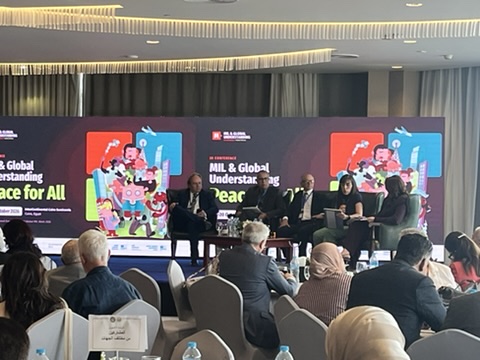

Some 150 participants from more than 15 countries call for a renewed media and information literacy able to meet the challenge of generative AI.
The Cairo Declaration 2026 was read out on 19 October at the Closing Ceremony of the III MIL & Global Understanding Conference: Peace for All, held in Cairo from 18 to 20 October 2026 as the Arab States regional event of UNESCO’s Global Media and Information Literacy (MIL) Week 2026. Its main outcome is a Plan of Action with four milestones to 2028: Almería, Castellón, Salamanca and Paris.
The Declaration also calls for renewing the MIL paradigm so that it integrates AI literacy, and welcomes the founding of the Media and Information Literacy International Scientific Association (MIL/ISA). The Conference was organised by the Arab Academy for Science, Technology and Maritime Transport (AASTMT) and the Universitat Autònoma de Barcelona (UAB). It brought together researchers, educators, media professionals, students and institutional representatives.
Three days in Cairo
The 2026 edition continues the process launched with the Cairo 2024 Declaration for Global Understanding and Peace and followed by the Barcelona 2025 MIL Action Agenda. It was developed in cooperation with the League of Arab States, the UNESCO MIL Alliance, the UNESCO UNITWIN MILID Network and the MIL Institute, under the Global MIL Week 2026 theme “We All Play a Part – Media and Information Literacy for the People”.
Sunday 18 October – MIL Global Policy Forum. The Opening Ceremony at the InterContinental Cairo Semiramis was presided over by Prof. Dr. Ismail Abdel Ghafar, President of the Arab Academy and President of the Conference. It was attended by H.E. Ibrahim Saber, Governor of Cairo; H.E. Ambassador Ahmed Rashid Khattabi, Assistant Secretary-General and Head of the Media and Communication Sector of the League of Arab States; H.E. Sergio R. Carranza Förster, Ambassador of Spain to Egypt; and Paul Coustère, Director of the UNESCO Regional Office in Cairo.
A High-Level Panel followed, moderated by Co-Director Samy Tayie (AASTMT), with Adeline Hulin, Head of the Media and Information Literacy and Digital Competencies Unit at UNESCO; Co-Director José Manuel Pérez Tornero, UNESCO Chair on MIL and Quality Journalism (UAB); and Vítor Tomé (Universidade Autónoma de Lisboa). Four Policy Forum roundtables then addressed MIL and peace education in AI-mediated societies; AI, disinformation, hate speech and democratic resilience; algorithmic governance, ethics and accountability; and technological innovation and global citizenship. The Co-Directors closed the day with the rapporteurs’ conclusions.
Monday 19 October – Congress and Arabic-language sessions. In the international hall, the International Scientific Congress held three roundtables: MIL research, theory and method; AI, citizenship and youth; and MIL in education and living spaces. Its 16 speakers from 11 countries gave short, slide-free presentations followed by open debate. In parallel, two Arabic-language halls hosted six sessions, with more than 40 speakers, moderators and rapporteurs, on language and MIL to counter misinformation, AI (“Minds Over AI”), media ethics, and intercultural and interfaith understanding. At 17:00 all halls came together for the Closing Ceremony, presided over by Prof. Dr. Abdel Ghafar, where Dr Sally Tayie read out the Cairo Declaration.
Tuesday 20 October – Young people and next steps. The final morning opened with the Young Peace Ambassadors Initiative, moderated by Sally Tayie, with students and doctoral researchers from Egyptian and Spanish universities. The Conference ended with “New Momentum for MIL: Peace for All”, in which the Co-Directors presented the conclusions, the next steps and the newly founded MIL/ISA.
What the Declaration says
The Declaration starts from a diagnosis. Generative artificial intelligence is now embedded in search engines, social media, education and news production. Synthetic content has reached electoral campaigns and armed conflicts, while models, data and computing capacity are concentrated in very few companies and countries.
A renewed MIL paradigm. The participants call for MIL to integrate AI literacy as one of its core dimensions, in line with UNESCO’s AI competency frameworks and the EU Artificial Intelligence Act. The renewal keeps the fundamental values of MIL: critical thinking, creativity, participation, inclusion, ethics and intercultural dialogue. It also opens new lines of research on the nature of generative systems, the authenticity and provenance of content, authorship, and human autonomy in relation to automated systems.
Power, not only content. The Declaration notes that platforms, social media and AI have brought about a deep mediatisation of social life. MIL must therefore look beyond content and competencies, and analyse the ownership, management and concentration of power that AI is accelerating. The participants advocate democratic participation in the governance of technologies; algorithmic transparency, with independent auditing and researchers’ access to data; and an open, decentralised AI that protects privacy.
Information integrity and peace. The text stresses that MIL, together with independent journalism, is a condition for information integrity and a contribution to education for peace. This requires independent research with rigorous methods and shared indicators, teacher training, and recognising young people as agents in the transformation of digital environments.
Two initiatives
MIL/ISA, a home for MIL research. The Declaration welcomes the founding of MIL/ISA. MIL research, it notes, remains fragmented across disciplines, languages and countries, while policies need a sound and independent knowledge base. The new association will bring together researchers from all regions, support doctoral candidates and early-career researchers, develop a line of publications and promote knowledge transfer; the participants invite researchers to join it.
MIL Young Peace Ambassadors. The Declaration also recognises the MIL Young Peace Ambassadors Programme, developed within the UNESCO UNITWIN MILID Network. The programme trains students and young researchers in the critical analysis of media and in creating campaigns for MIL, human rights and intercultural dialogue. The participants support its consolidation as an international network, its extension to new regions and the evaluation of its results.
The Plan of Action: four milestones to 2028
Under the umbrella of the MIL & Global Understanding Conference, the participants agreed on four milestones:
- Almería, February 2027. A working seminar with universities and partners from both shores of the Mediterranean to establish a Mediterranean MILID network on MIL, information integrity and intercultural dialogue. It will identify capacities and priorities, define research lines and prepare funding applications, including for calls linked to the Mediterranean University of the EU’s Pact for the Mediterranean and to a joint UNESCO–EU initiative on information integrity in the Mediterranean.
- Castellón, 14–16 April 2027. The 18th International Congress on Local Communication (ComLoc 2027), at Universitat Jaume I, on “Media Literacy in the Media in Europe and Spain”. The MIL & Global Understanding initiative will bring the perspective of the Declaration to it.
- Salamanca, October–November 2027. The IV MIL & Global Understanding Conference, at the University of Salamanca, will review the plan and open a new stage of work.
- Paris, spring 2028. A joint seminar with the UNESCO UNITWIN MILID Network will review the progress of the Mediterranean network, MIL/ISA and the Young Peace Ambassadors Programme.
The Co-Directors of the Conference will coordinate the follow-up and report on it in Salamanca. The participants closed by reaffirming their commitment to “MIL for all, contributing to more democratic, more just and more peaceful societies”.
Read the full text: Cairo Declaration 2026 (English)


Add Comment