


Education · What Media Literacy Means Where You Are · Episode 1: Africa
“If we do not tell African stories, who will?”
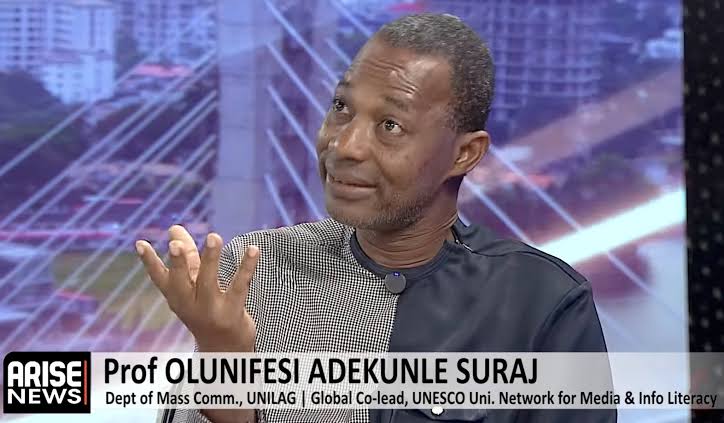
Prof. Olunifesi Adekunle Suraj on media literacy in Africa, disinformation, oral tradition, and why the global MIL conversation is incomplete.
Media literacy in Africa is not a distant aspiration; it is being built, right now, from Lagos outward. In December 2024, Prof. Olunifesi Adekunle Suraj inaugurated the African Chapter of the UNESCO/UNAOC MILID University Network with an address titled “The Africa We Want.” His message was direct: Africa could no longer afford to receive media and information literacy frameworks designed elsewhere and applied here as if context did not matter.
Associate Professor of Strategic Communication and Digital Media Literacy at the University of Lagos, Global Co-Lead of the UNESCO MILID University Network, and Executive Director of the African Centre for Media and Intercultural Dialogue (ACMID), Prof. Suraj is one of the most consequential architects of MIL on the African continent today.
The missing narrative
African MIL initiatives exist, and they are significant. But they go under-reported and under-represented in global conversations. The result, Prof. Suraj argues, is a global narrative with a structural gap.
“Global narratives of MIL will not be completed without proper articulation of African MIL initiatives. Global initiatives can only supplement — not supplant.”
The guidelines produced for UNESCO yearbooks, he notes, are written as if they apply everywhere equally. If he does not write the African chapter, who will?
The educated citizen
During the COVID-19 pandemic, Africa was stigmatised by global media narratives linking the continent to the virus. Fact-checkers stepped in but Prof. Suraj found they too had blind spots, relying on predictive data rather than confirmed realities, and operating according to economic agendas. “We need to fact-check the fact-checkers,” he says.
This experience shaped his concept of the “educated citizen” not simply someone who attended school, but someone equipped with the keys to MIL: the ability to question, produce, and verify. An educated citizen recognises the symptoms of disinformation, anxiety, fear, the impulse toward hasty action and knows how to interrogate them rather than act on them.
Media Literacy Beyond Digital: Oral Tradition in Africa
Internet penetration across Africa remains profoundly uneven. Prof. Suraj refuses to treat digital literacy as the only valid framework. Proverbs, oral traditions, communitarian life these are not obstacles to MIL. They are MIL, expressed in African terms. When the West dismisses African idioms as irrelevant, he pushes back: superior reasoning does not require a smartphone.
“No one can tell African stories better than Africans,” he says. His message to young educators and activists entering the field is equally clear: come prepared, stay curious, and never stop learning. “Critical to all these preparations is the mind activation the essence of critical thinking.”
Prof. Olunifesi Adekunle Suraj is Associate Professor of Strategic Communication, Disinformation and Digital Media Literacy at the University of Lagos, Continental Coordinator of the African Chapter of the UNESCO MILID University Network, and Executive Director of ACMID.
Hana Bounama, doctoral researcher, PhD Programme in Communication and Journalism, Universitat Autònoma de Barcelona.




Add Comment