

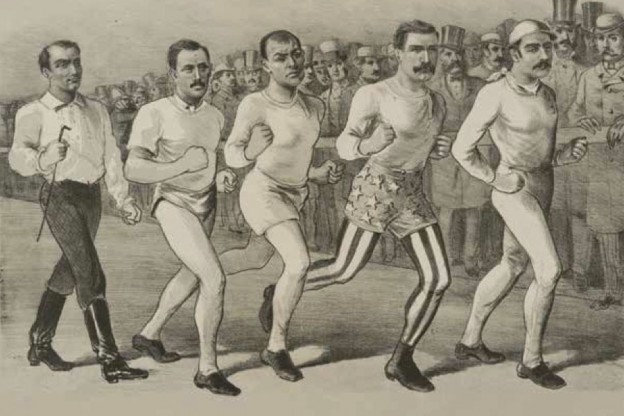

Today, when the map seems to be traced once again with trench lines, it is worth looking back to a nineteenth century in which gunpowder also set the pace—and yet an unexpected “ceasefire” emerged. It was not declared by embassies or treaties: it was suggested by sport and the press, which offered a field of competition where nations could measure themselves without destroying one another, in a language that needed no translation and required only a minimal recognition of the other. The story of Achilles Bargossi, recovered from newspaper archives across half the world, shows that this ideal was not born in Coubertin’s salons or in the stadiums of the twentieth century, but on dusty roads, improvised racecourses, and in bullrings where a thin, stubborn Italian ran against men and horses… and where newspapers, by telling the story, built bridges instead of borders.
I have spent several years tracing Bargossi’s newspaper footprint through digital and physical archives in more than twenty countries. What began as a curiosity—a nineteenth-century pedestrian who raced against men and horses—gradually revealed itself as something far more significant: the story of how journalism and sport, allied without any prior program, wove ties between nations that official diplomacy was incapable of creating.
The context matters. The last quarter of the nineteenth century was hardly an era of concord among European nations. The great powers fought over colonies around the world with a voracity that the partition of Africa, agreed upon in Berlin in 1884, helped to institutionalize. Nationalism permeated public life, military alliances multiplied, arms races accelerated, and the general climate was one of mutual distrust. In that setting, the figure of an Italian runner competing against Frenchmen, Englishmen, Austrians, Spaniards, Egyptians, Ottomans, and South Americans was, to say the least, striking. And when newspapers amplified these contests and carried them to readers across the globe, the effect multiplied.
Bargossi died in Argentina in 1885 at only thirty-eight, probably worn down by a life of exertions that would seem reckless to us today. Between his debut—a modest wager between Milan and Monza in 1873—and his last documented race in Buenos Aires, he travelled across three continents. He competed in Italy, France, Switzerland, England, the Austro-Hungarian Empire, Greece, the Russian Empire, the Ottoman Empire, Egypt, Algeria, Malta, Portugal, Spain, Brazil, Uruguay, and Argentina. The list of his rivals is itself a portrait of the world of his time: horsemen from Vienna’s Prater, Egyptian saïs, Spanish pedestrians, English pedestrians, and Brazilian slaves, to name only a few.
Three hundred newspapers before the internet
What turned Bargossi into more than a travelling athlete was the press. Without it, each race would have been a local episode, forgotten within weeks. With it, his feats reached a circulation that still astonishes today. My research began with an initial collection of three hundred press clippings; six years later, references to him had turned up in newspapers written in more than a dozen languages: German, French, English, Italian, Spanish, Portuguese, Dutch, Hungarian, Finnish, Norwegian, Swedish, Polish, and Romanian. There was probably at least one more language I have not been able to document, given my unfamiliarity with non-Latin alphabets.
One must understand the machinery that made this possible. The agencies Havas, Reuters, and Wolff had divided the planet into information spheres after their 1870 agreement. A telegram about an athletic race held in a Madrid bullring could reach editorial desks in Melbourne or Montreal within hours. Sports news travelled along the same undersea cables as stock quotations and diplomatic bulletins—giving athletic spectacle a reach that would have astonished any entrepreneur of the time.
What was different about sports reports
There is one aspect I consider crucial, and one that is often overlooked. The political and military news that filled front pages almost always fuelled distrust between peoples: the Russian threat, the Alsace question, colonial skirmishes—everything pointed toward suspicion and rivalry. Sports reports, by contrast, offered something different. When a Paris newspaper described how Bargossi had covered one hundred kilometres in an astonishing time, a French reader could admire the Italian without feeling his patriotism was compromised. No territory was at stake, no treaty to negotiate, no national humiliation to avenge—only a man running, and other men, from any country, recognizing the feat.
This ability to generate cross-border admiration at little political cost is what made sport such an effective vehicle for understanding. No one planned it that way. Bargossi did not set out to be an ambassador of peace, nor did newspaper editors believe they were building universal brotherhood. But the result, seen from a distance of a hundred and fifty years, clearly points in that direction.
Nine thousand people at the Prater
Some episodes capture the idea particularly well. In August 1881, the Rotunde at Vienna’s Prater hosted one of Bargossi’s most talked-about races. Nine thousand spectators attended—a remarkable figure for any event of the era. Among the crowd, according to the Allgemeine Sport-Zeitung, was King Kalākaua of Hawai’i, then touring Europe. Prince Solms, Baron Isidor Majthenyi, and Margrave Alfred Pallavicini were also present. On the track, Bargossi competed against a German and an Austrian rider—bound by the same rules, measured by the same stopwatch.
The Viennese newspaper covered the race with what we would now call professional rigor: it recorded split times kilometre by kilometre, described the effort with technical precision, and analyzed each competitor’s strategy. By treating athletes of different nationalities with equal seriousness, it established a principle of equality that clashed with the Europe of the time—an Europe obsessed with racial and national hierarchies. The Prater’s circular track—two hundred metres on which everyone ran under the same conditions—became a metaphor for a more equitable order, even if no one put it that way then.
A slave named Teodoro
If one episode justifies interest in this story all by itself, it is what happened in Campinas. It took place in September 1885, just weeks before Bargossi’s death. The Brazilian press had announced that the Italian champion would face several rivals at the local hippodrome. One of them was Teodoro, a Black slave. They ran thirty-two kilometres. Teodoro ran as if his life depended on it—or his freedom, which for him must have been almost the same thing. He lost by barely fifty metres.
What followed exceeded any expectation. The crowd rose to its feet, acclaimed the slave, and carried him out of the hippodrome on their shoulders. Several officers and gentlemen present offered money for his emancipation. A spontaneous collection raised what was needed to buy his freedom. That same night Teodoro paraded through the streets of Campinas accompanied by a band, now as a free man. When he received his manumission letter, he chose a new surname: that of the man who had defeated him. From then on, he was called Teodoro Bargossi.
Diario de Notícias (Brazil) reported the story in detail. I do not believe there is, in the whole nineteenth century, a more eloquent testimony to the power of sport to cross social barriers. The race placed the slave and the European champion on a plane of momentary equality. And that fleeting equality on the track translated into a real and definitive change in one man’s life. The fact that the press spread it made it more than a local anecdote.
Farewell to Signore Bargossi at Madrid’s Buen Retiro Gardens (1882). Poster, 32 × 15 cm.
Spain: the Bielsa case
Bargossi’s arrival in Spain in the summer of 1882 caused a media stir that deserves a chapter of its own. When the Aragonese runner Mariano Bielsa defeated him that autumn in Zaragoza, newspapers celebrated the feat as a victory of almost military dimension. The poet Valentín Marín Carbonell composed epic verses that make us smile today. La Ilustración Española y Americana commissioned an engraving of the winner. The ensuing controversy—mutual accusations of cheating and bad faith—filled Spanish newspaper pages for weeks. I have counted hundreds of press references in that year alone, from Faro de Vigo to La Vanguardia, from Diario de Córdoba to La Crónica de Teruel: no paper ignored the affair.
At first glance, this episode seems to contradict the thesis of sport as an instrument of fraternity. Passions flared, national pride overflowed, and rivalry took on a bitter tone. But it is worth looking more closely. The contest was held under agreed rules, before a jury of men of honor. And the subsequent dispute—long and heated—was fought in newspaper columns, not in the streets. Bargossi sent his account of the lost race to La Correspondencia de España. Bielsa replied in El Liberal, asserting his unquestionable victory. Their representatives negotiated a rematch in the pages of La Época. The battlefield was ink. That a barefoot Aragonese runner could defeat an international champion, and that half of Europe took note, was significant. It was, in essence, a form of sporting democracy far more civilized than the usual ways nations settled rivalries at the time.
A runner who thought
There is another side of Bargossi worth mentioning, because it completes his profile in an unexpected way. He was not only an athlete; he was also a man with his own ideas about physical education. He drafted a project for a training school that he presented to the governments of Italy, France, Spain, and the Ottoman Empire. His argument was that training the body constituted a shared heritage of humanity. He invoked the Greeks and Romans, as was customary then, and argued that modern nations should recover that tradition.
Before the Ottoman sultan he demonstrated running exercises. Before Alfonso XII he completed thirty kilometres between the Casa de Campo and El Pardo. Before French authorities he argued that his method could improve army training. We do not know how successful these efforts were, since the archives are sparse. But in every case the press reported both the physical feat and the runner’s pedagogical proposals, helping to circulate internationally ideas that—decades before Baron de Coubertin articulated the Olympic ideal—already pointed toward physical education as a universal good.
The printing presses went farther than his legs
Bargossi’s feet stepped on sixteen countries, but his name—thanks to the printing presses—reached places he never visited: Finland, New Zealand, Canada, Romania. Nineteenth-century sports journalism did not merely record the birth of modern sport; it took an active part in creating it. Newspapers manufactured a shared, transnational space in which readers in very different countries followed the same protagonists and were moved by the same stories. That community of readers matched no border and yet was perfectly real.
In a century dominated by aggressive nationalisms and imperial wars, sport and the press offered something diplomacy could not. They did so without meaning to. They offered a ground on which nations could measure themselves without destroying one another; a language that required no translation; a space of mutual recognition. The story of Bargossi, patiently recovered from newspaper archives around the world, is proof that this ideal was not born in Baron de Coubertin’s salons, or at the first Olympiad (1896). Nor was it born in twentieth-century stadiums. It was born on dusty roads, in makeshift hippodromes, and in bullrings, where a thin, stubborn Italian ran against men and horses. And it was born because newspapers told his story.
Donato Gómez Díaz is the author of Andarines y deporte en España durante el siglo XIX: de oficio a espectáculo. Una historia socioeconómica. University of Almería (Spain) Press, 2024.
Donato Gómez Díaz is the author of Andarines y deporte en España durante el siglo XIX: de oficio a espectáculo. Una historia socioeconómica. University of Almería (Spain) Press, 2024.





Add Comment